









Mandatory Driver's Insurance (TPVCA): A Complete Guide, Coverage Amounts, and Cost
It’s not just a technically sound car that gives you peace of mind on the road. It’s just as important to know that, in the event of an accident, you won’t have to cover third-party damages out of your own pocket—that’s exactly what compulsory motor vehicle liability insurance is for.
In this guide, we’ll explain—without dry legal jargon—what MTPL insurance actually covers, what factors determine its price, and how to compare offers from nearly all Lithuanian insurers in one place in less than a minute. If you want to see the price right away, enter your license plate number in the calculator at the top. If you want to understand what you’re paying for, keep reading.
What is mandatory civil liability insurance?
Mandatory civil liability insurance for vehicle operators—commonly abbreviated as TPVCA, and known in legislation as TPVCAPD—is a legal obligation for every vehicle operator. The logic behind it is simple: it protects the interests of third parties, not your own.
If you cause a traffic accident, your insurer—not you personally—covers the cost of repairing the victim’s car, damaged property, or medical expenses. In this respect, this insurance differs fundamentally from comprehensive insurance (KASKO), which covers your own property. It is simply prohibited to drive on public roads without a valid policy—this ensures the financial security of all road users.
TPVCA or KASKO? What’s the Difference Between Mandatory and Voluntary Insurance?
These two concepts are often confused, so it’s worth clarifying them once and for all. Mandatory insurance is a legal obligation, while KASKO is a voluntary decision on your part to protect your own car.
In short, TPVCA is a minimal but mandatory layer of protection, while KASKO insurance is an additional shield for your own car. Many drivers combine the two: mandatory insurance because it’s required by law, and comprehensive insurance for peace of mind.
What is covered by mandatory insurance: coverage limits
Although the policy costs just a few dozen euros a year, the coverage it provides is worth millions. The law sets maximum coverage limits that the insurer is obligated to pay to victims for a single traffic accident:
Where coverage applies: Lithuania, the EU, and the Green Card
With a valid policy, you can cross national borders with peace of mind. Coverage automatically applies in all countries of the European Economic Area and Switzerland. If you’re traveling further—for example, to the United Kingdom, Turkey, or the Balkan countries—you’ll need to extend your policy’s coverage with a Green Card, which extends coverage to other countries in the Green Card system. You can obtain it from your insurer; if you’re planning a longer trip, it’s worth taking care of this in advance and not forgetting to get travel insurance that covers the traveler rather than the car.
What are the risks of driving without insurance?
Traffic accidents are unpredictable and can cost thousands of euros. Without vehicle insurance, you would have to bear the entire financial burden yourself. The fine itself seems symbolic compared to the actual risk:
However, the real threat lies not in the fine. If you cause an accident while uninsured, the Motor Insurers’ Bureau will first compensate the victim for the damages—but then it will recover the entire amount paid, even if it’s several tens of thousands of euros, from you through a subrogation claim. In such a case, a single moment of carelessness could cost you for years to come.
Who Needs Insurance: From Scooters to Tractors
We usually talk about car insurance, but the requirement applies to all registered vehicles participating in public traffic. The insurer’s calculator allows you to insure any category:
For heavy and specialized equipment—such as tractors, excavators, or Bobcat-type machines—it’s often worth considering broader coverage in addition to the mandatory minimum. We cover this in more detail in our overview of special-purpose vehicle insurance.
Ride-Hailing and Commercial Activity Insurance
More and more drivers are providing services through platforms like “Bolt” or “Uber.” These vehicles spend significantly more time on the road, so the risk is higher—standard insurance may not be sufficient for them. It’s important not to make a mistake here: falsely stating the intended use of the vehicle is often the reason an insurer refuses to pay a claim after a traffic accident.
What determines the cost of mandatory insurance?
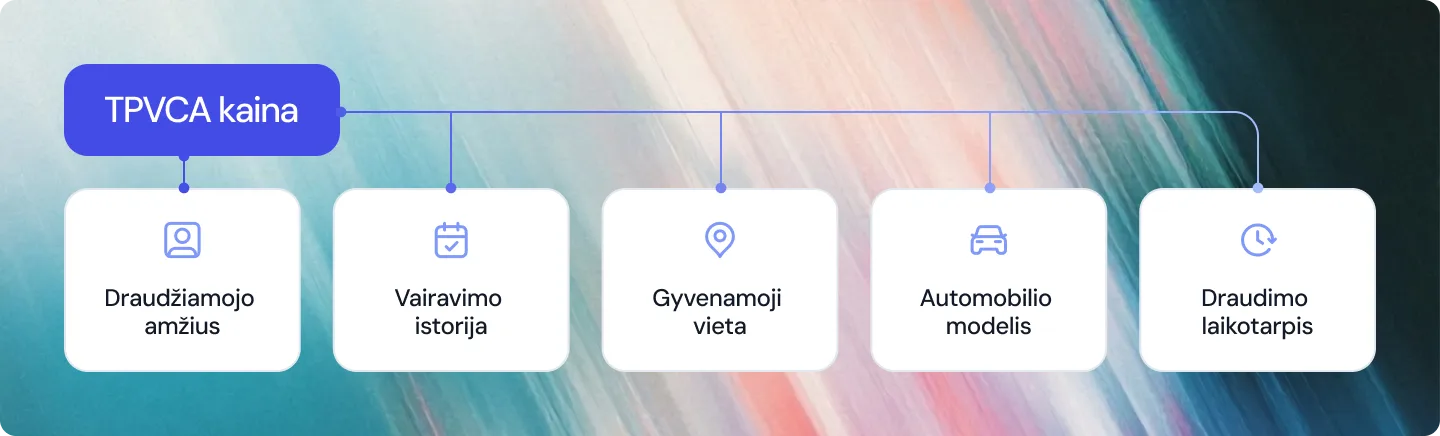
The premium isn’t a random number—it’s based on a risk assessment. The less risky the insurer considers you to be, the more favorable the price will be. The most important factors:
- Driving experience. The longer your accident-free driving record, the lower the price.
- Claims history. Every accident you’ve caused in the past 7 years increases your premium.
- Driver’s age. Drivers under 25 are classified as a higher-risk group.
- Place of registration. Traffic is heavier in large cities, so the risk there is higher than in smaller areas.
- Vehicle power. Statistically, more powerful cars are more likely to be involved in accidents.
- Additional drivers. If the car will also be driven by young people or those with a poor driving history, this is considered an additional risk.
- Insurance term. When purchasing a policy for the entire year at once, a discount is often applied compared to short-term insurance.
How does the insurance calculator work?
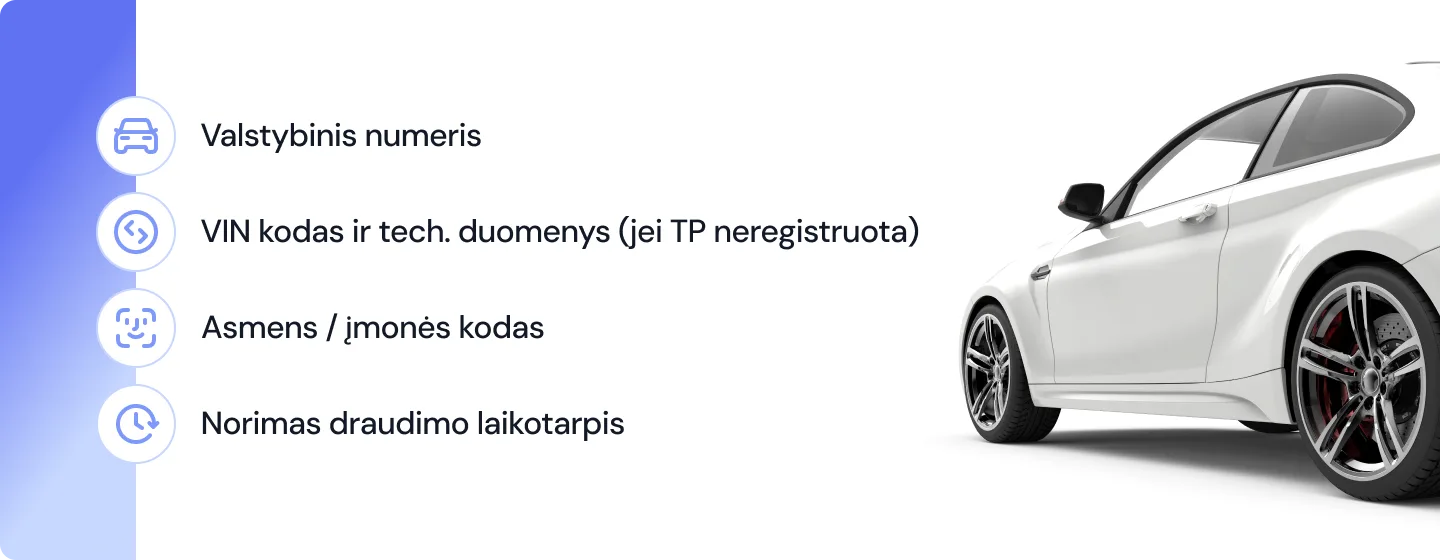
To save you from having to re-enter the same data on every insurer’s website, we’ve created a tool that does it all for you. The process consists of three steps:
Prices from all insurers in one place
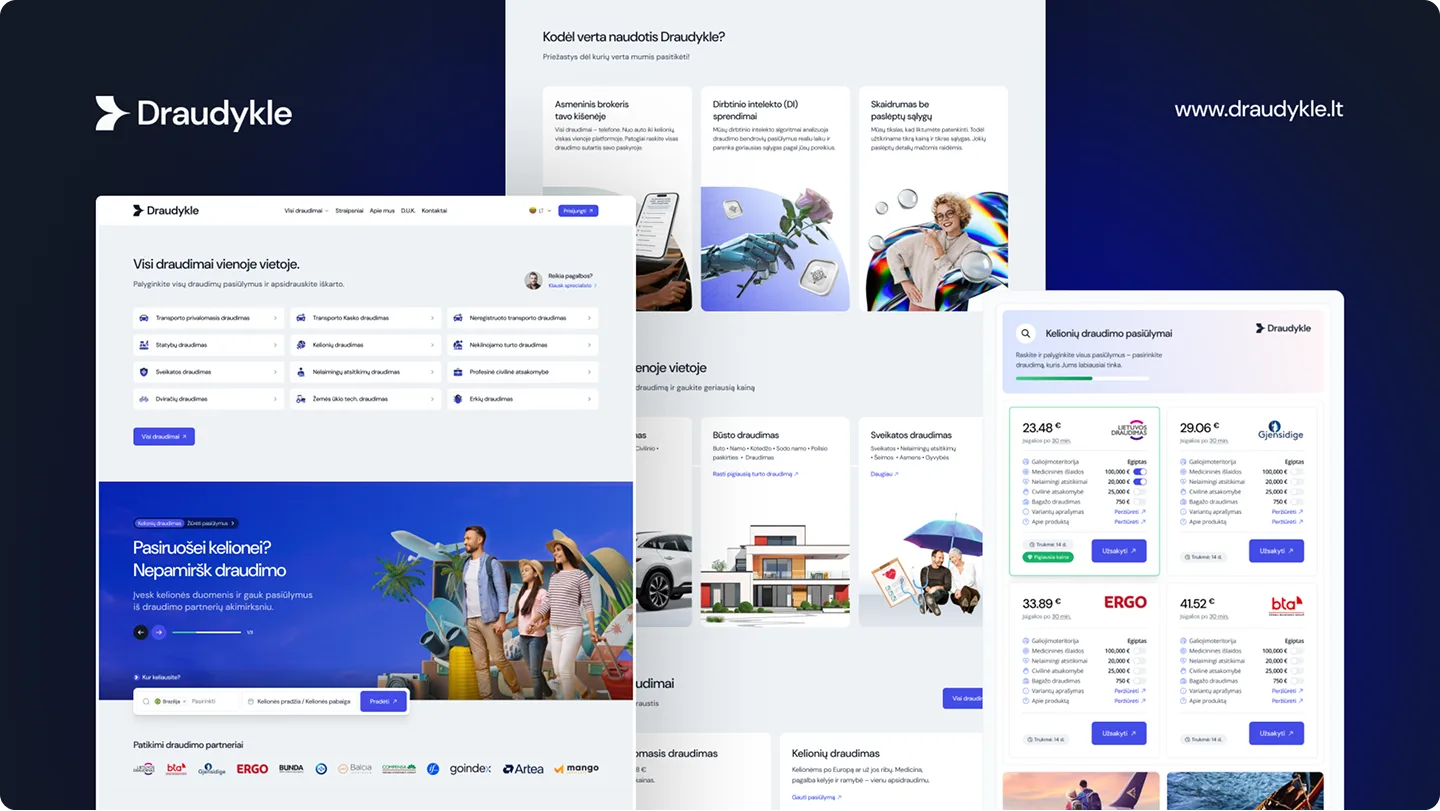
When using Draudykle, you’re not tied to a single insurer. We partner with nearly all insurance companies in Lithuania, so you can compare not only prices but also additional benefits—for example, roadside assistance after a mechanical breakdown or traffic accident, which is often available with a personalized discount.
Transparency is our priority. By seeing all offers in a single list, you can be sure you’re making the right financial decision—with no hidden fees or brokerage markups. And if you have questions about which option to choose, the Draudykle insurance assistant is here to help, explaining the differences between the offers in plain language.
Buying Insurance Online: Fast, Safe, and Convenient
Buying insurance online has become the norm. After filling out the calculator and selecting the most suitable option, you can pay in a convenient way—by bank transfer or credit card. Your valid policy will be sent to your email immediately, and information about the insured vehicle will be uploaded to centralized systems, so you don’t even need to carry it with you.
To ensure you’re never left without coverage on the road, we’ll send you a reminder before your policy expires—so you won’t have to mark the dates on your calendar yourself or worry about missing the deadline.
Frequently Asked Questions
Does mandatory insurance transfer to the new car owner?
No. When the owner changes, the previous policy becomes invalid, and the new owner must take out a policy in their own name. That’s exactly why you need to arrange insurance immediately after purchasing a used car.
Can I get insurance on the same day my old policy expires?
Yes. The most important thing is to ensure there are no days without coverage between the old and new policies if the vehicle is used on public roads.
Is the TPVCA policy valid abroad?
Yes, it is automatically valid throughout the European Economic Area and Switzerland. When traveling to other countries in the Green Card system, coverage must be extended separately with a Green Card.
How does mandatory insurance differ from comprehensive insurance (KASKO)?
TPVCA covers damage you cause to others, while comprehensive insurance (KASKO) covers damage to your own vehicle (theft, natural disasters, accidents caused by you). They are not substitutes for one another, but they complement each other perfectly.
Is compulsory insurance coverage the same across all companies?
The scope of coverage and the insured amounts are the same—they’re set by law. The only differences are in price and additional benefits, so it’s always worth comparing offers.
How much does mandatory insurance cost?
The price is individualized and depends on the driver’s history, age, the car’s horsepower, and the policy term. The calculator will provide the most accurate answer in a few seconds—just enter the car’s license plate number.